
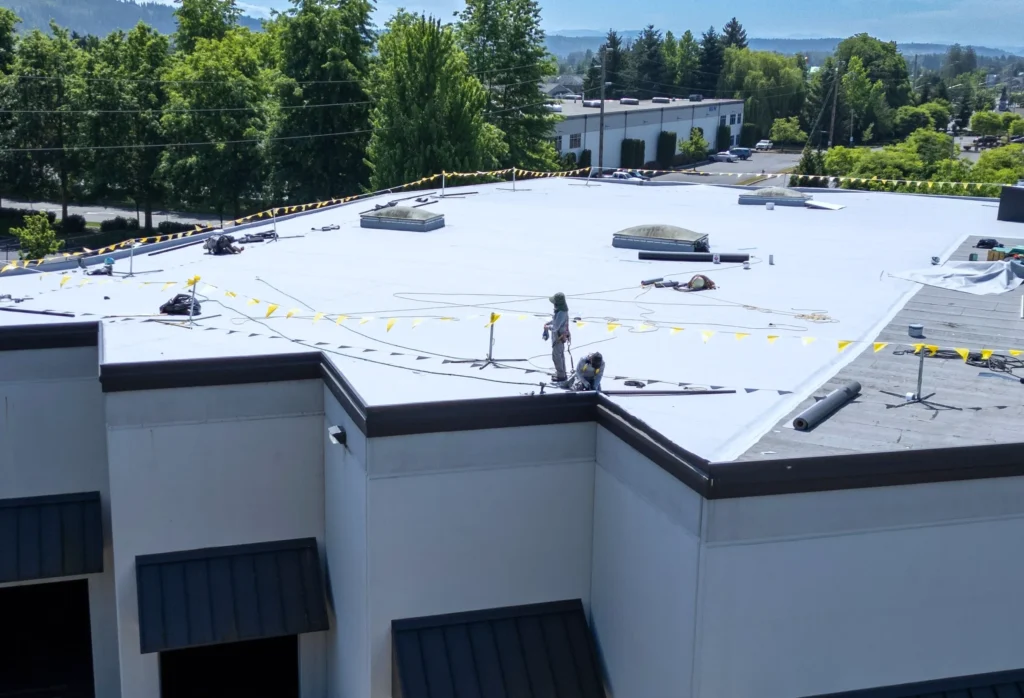
When a commercial flat roof fails in a Washington November, facility managers ask: Can single ply roofing be installed in cold weather?
Single ply roofing can be installed in cold weather, but falling temperatures reduce the flexibility of TPO and PVC membranes and complicate EPDM seam adhesion. Navigating these material changes requires experienced single ply roofing contractors who understand winter application standards.
The Cold Weather Membrane Chart: TPO, PVC, and EPDM
Different commercial roofing materials respond differently to dropping temperatures. Understanding these changes helps facility managers plan winter roofing projects without compromising the building envelope. Manufacturers engineer these membranes to perform well once installed, but the installation process changes significantly in cold conditions.
| Membrane Type | Physical Reaction to Cold | Winter Installation Adjustment |
| TPO (Thermoplastic Polyolefin) | Becomes stiffer and may require additional time to relax and lay flat. | Requires careful heat-welding temperature and speed adjustments to achieve complete seam bonds. |
| PVC (Polyvinyl Chloride) | Becomes less flexible and requires careful handling to avoid cracking or damage. | Should be handled cautiously and staged in heated areas until deployment. |
| EPDM (Ethylene Propylene Diene Terpolymer) | Retains more flexibility than thermoplastics, but still requires proper conditioning and cold-weather installation practices. | Requires longer adhesive flash times, tack testing, and heated storage for temperature-sensitive products. |
Why Thermoplastic Membranes Struggle in the Cold
TPO and PVC become stiffer as temperatures fall, making handling and seam welding more demanding. A cold roll of TPO may resist laying flat across the insulation board until it has had time to relax.
This stiffness creates challenges at the seams. Thermoplastics require hot-air welding to fuse overlapping sheets. Cold air and wind pull heat away from the weld area. If a crew does not adjust temperature, speed, and pressure for the conditions, the weld may be incomplete or weak rather than fully fused. Crews should also perform test welds and confirm the substrate is dry before production welding begins.
PVC requires particular care in cold weather. The material becomes less flexible, so crews should handle it cautiously and allow it to relax before installation. Keeping rolls in a heated staging area until they are needed helps reduce handling damage and supports a more reliable installation.
The Hidden Adhesive Risks With EPDM
EPDM handles physical cold better than thermoplastics. As a synthetic rubber, it generally remains more flexible and is easier to handle in cold conditions. The greater challenge is the chemical adhesion required for seams and flashing details.
EPDM seams often rely on primers, seam tape, and compatible bonding adhesives. Cold weather thickens these products and slows flash time, ot the period needed for solvents to evaporate before surfaces are joined.
Pressing seam materials together before the adhesive has properly flashed can compromise adhesion and seam quality. Experienced single ply contractors follow the manufacturer’s tack-test and flash-time requirements. They also store temperature-sensitive adhesives and primers in heated boxes on the roof to maintain workable consistency.
Winter Requirements for Single Ply Roofing Experts
Installing a commercial roof in cold weather requires a different approach. Because materials and adhesives respond to temperature, installation methods must adapt. A crew that treats a winter project like a summer job increases the risk of seam or adhesion problems.
- Temperature Calibration: Crews adjust automatic welders for ambient temperature, wind exposure, and substrate conditions.
- Material Staging: They allow TPO and PVC rolls to relax and stage temperature-sensitive materials in heated areas until needed.
- Warranty Compliance: They follow the manufacturer’s temperature, substrate, and application requirements. Installing outside those requirements can jeopardize warranty coverage.
Related Articles:
- Which Is Best for PNW Rain? TPO vs. PVC Single Ply Roofing
- Top TPO Roof Replacement Options for Tacoma Businesses
Secure Your Commercial Roof With Fields Roof Service
Installing a commercial flat roof in freezing weather leaves no room for material errors. Successfully deploying TPO, PVC, or EPDM in the cold requires a crew that knows exactly how plummeting temperatures impact seam integrity.
Fields Roof Service installs commercial roofs built for heavy Pacific Northwest rain. We evaluate your deck, recommend the right membrane for the season, and adjust our application techniques to the exact temperature so your new seams hold tight.
Contact us today to schedule an inspection with certified single ply roofing contractors and secure your building envelope this winter.