Washington rainstorms can expose weaknesses in poorly designed, damaged, or badly installed low-slope roofs. Choosing an unsuitable membrane for a building’s chemical exposure, drainage conditions, or rooftop traffic can increase leak risk during the first major autumn downpour. Choosing a material based only on the lowest bid can also lead to higher maintenance costs later.
Smart facility managers rely on experienced single ply roofing contractors to match the membrane to the building’s actual hazards. To protect your property, you must understand how TPO, PVC, and EPDM respond to moisture, ponding, chemicals, and daily use.
Which Single Ply Roofing Membrane Handles Heavy Pacific Northwest Rainfall Best?
TPO and PVC single-ply membranes can provide strong moisture protection for commercial roofs when properly designed, detailed, welded, and maintained. PVC generally offers stronger resistance to grease, oils, and many chemicals, while TPO is often a cost-competitive option with a reflective surface that may support energy-efficiency goals. EPDM remains a widely used thermoset rubber membrane, but its adhered or taped seams and chemical compatibility require careful review for each application.
Single-Ply Thermoplastic Membrane Wet Weather Performance Matrix
Comparing these materials requires a close look at how they perform under real operating conditions.
| Material Type | Seam Method | Puncture Resistance | Chemical Tolerance | PNW Rainfall Performance |
| PVC (Polyvinyl Chloride) | Strong heat-welded seams | Generally high; varies by product | Generally high against grease and oils; verify specific compatibility | Strong when properly designed and drained |
| TPO (Thermoplastic Polyolefin) | Strong heat-welded seams | Moderate to high; varies by product | Limited for some oils, greases, and chemicals | Strong when properly designed and drained |
| EPDM (Rubber) | Adhered or taped seams | Generally good; varies by system | Limited with petroleum products, oils, and greases | Proven option when compatible with the exposure |
Why Expert Single Ply Roof Installers Trust Heat-Welded Seams
Property managers often obsess over membrane thickness while overlooking the roof’s most failure-prone details: seams, flashings, penetrations, and perimeter edges. EPDM depends on primers, adhesives, and seam tape to join its sheets. Those materials can perform well when properly installed, but chronic ponding, poor preparation, contamination, and aging can turn a small seam defect into an active leak.
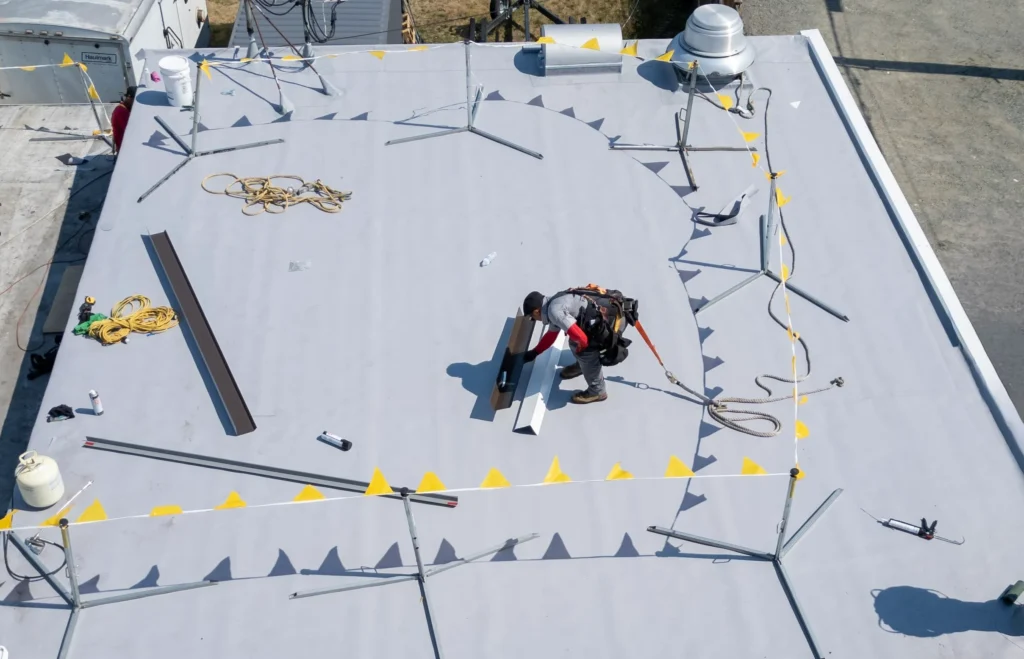
This is where TPO and PVC hold a decisive installation advantage. Professional crews use hot-air welders to fuse overlapping sheets into continuous, watertight joints rather than relying on taped field seams. Properly welded thermoplastic seams resist rain and routine weather exposure. They do not make the roof failure-proof, however. Poor welding, defective flashing, open penetrations, weak perimeter details, and inadequate drainage can still compromise the system. Heat-welded seams are a major advantage, but only when experienced installers execute and inspect them correctly.
How Restaurant Grease Affects Flat Roofs
Water is not the only hazard affecting a commercial roof system. Restaurants, manufacturing facilities, and industrial plants may discharge grease-laden exhaust, oils, or chemical vapors near rooftop membranes. The effect depends on the substance, concentration, temperature, exposure duration, ventilation design, and membrane manufacturer’s compatibility data. Grease and oil exposure can damage membranes that are not formulated for that environment.
PVC is often considered when a roof will receive substantial grease, oil, or chemical exposure because it generally offers stronger resistance than EPDM and standard TPO. However, proper exhaust design, grease containment, flashing, and routine cleaning remain necessary. A roofing professional should verify the actual exposure before specifying PVC or another membrane.
Making the Choice With a Professional Single Ply Roofing Company
For a standard retail space or office building without significant grease or chemical exposure, TPO can provide competitive value and strong heat-welded seams. Its reflective surface may also help reduce solar heat gain, although actual energy savings depend on insulation, HVAC performance, building use, and climate. PVC may offer advantages that justify its cost when chemical or grease exposure is documented.
An experienced single-ply roofing contractor reviews exhaust systems, rooftop traffic, drainage, slope, insulation, substrate condition, fire requirements, warranties, and project budget before recommending a membrane system.
Related Articles:
- Single Ply Roofing Systems Guide From Everett Contractors
- Bellevue Commercial Roofs: Modified Bitumen vs. Single-Ply
Build a Tougher Commercial Roof Today
Protecting a massive commercial facility requires matching the right chemistry to your specific weather hazards. Washington storms quickly destroy the wrong materials in a matter of months.
Fields Roof Service evaluates your building use, your drainage, and your chemical exposure to specify the perfect waterproof membrane. We focus on the small welding details that keep standing water out of your building.
Schedule a thorough inspection with the region’s top single ply roofing contractors. Contact us!